 English
 Deutsch
 Nederlands
 Español
 Français

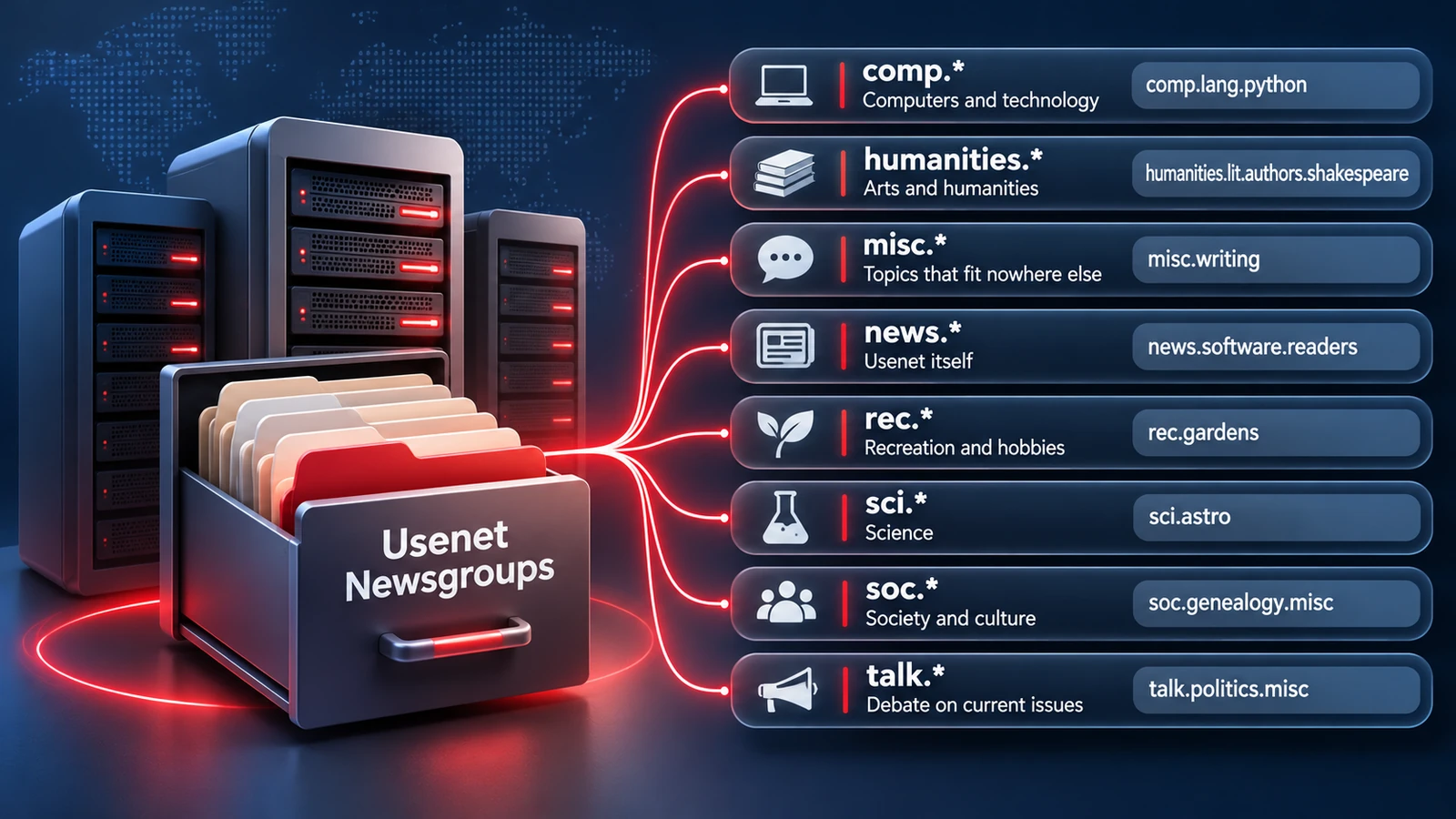
What Is a Newsgroup Hierarchy?
Usenet sorts its groups into a family tree. A newsgroup’s name reads from the general to the specific, with each dot taking you one level down. In comp.os.linux.networking, comp means computers, os means operating systems, linux narrows it to Linux, and networking is the topic of the group itself.

Each level is called a hierarchy, and the first part of the name is the top-level hierarchy. When people write comp.*, the star means “everything below”: the comp hierarchy and every group in it.
Why Usenet uses hierarchies
- Finding related groups. Groups on similar subjects sit side by side, so one good group leads you to its neighbors.
- Placing new groups. A new group goes where people interested in its topic are already looking.
- Running servers. News servers can carry or leave out whole hierarchies, such as the one for a particular country.
- Setting rules. Each hierarchy has its own caretakers and its own rules for creating groups.
Learn moreHow news servers keep each hierarchy up to date
Each hierarchy’s caretakers publish digitally signed announcements that tell news servers which groups to add or remove, along with a full list of the hierarchy’s groups. A server’s settings record whose announcements to trust for each hierarchy, so an official announcement for de.* is accepted while a forged one is ignored. The Internet Systems Consortium keeps a widely used register of hierarchies and their caretakers that many servers rely on.
Key takeaway
A newsgroup’s name is its address in the family tree: the first part is the hierarchy, and each step after it narrows the topic.
The Big 8 Hierarchies
The Big 8 are Usenet’s eight main hierarchies, with formal, public rules for creating and removing groups. The Big-8 Management Board looks after them, and its official list from October 2026 counts 1,897 groups:
comp.* Computers
677 groupsComputers in every form: programming languages, operating systems, hardware, security and networking. It’s the largest of the Big 8.
comp.lang.pythoncomp.os.linux.misccomp.security.misccomp.databases
humanities.* Arts and humanities
7 groupsThe newest and smallest of the Big 8, added in April 1995 for literature, music, languages and design.
humanities.classicshumanities.lit.authors.shakespearehumanities.music.composers.wagnerhumanities.design.misc
misc.* Everything else
100 groupsEveryday topics that don’t fit anywhere else, such as jobs, education, health, consumer issues and writing. It’s also home to misc.test, the place for test posts.
misc.writingmisc.educationmisc.consumersmisc.jobs.misc
news.* Usenet itself
26 groupsConversations about Usenet: newsreaders, new groups, running news servers and help for newcomers.
news.newusers.questionsnews.groups.questionsnews.software.readersnews.answers
rec.* Recreation and hobbies
659 groupsHobbies and pastimes: books, music, sports, games, travel, pets, cars, cooking and much more.
rec.food.cookingrec.travel.europerec.games.chess.miscrec.birds
sci.* Science
185 groupsScience and research, from mathematics and physics to astronomy, medicine, space flight and cryptography.
sci.mathsci.physicssci.astrosci.space.history
soc.* Society and culture
212 groupsHistory, family history, countries and cultures, religion and social issues.
soc.history.medievalsoc.genealogy.miscsoc.culture.japansoc.libraries.talk
talk.* Debate
31 groupsLong-running debate on politics, philosophy, religion and current issues. Expect strong opinions.
talk.politics.misctalk.philosophy.misctalk.environmenttalk.bizarre
Learn moreHow the Big 8 came about
In Usenet’s early years, most groups lived under net.*, with moderated groups under mod.* and groups passed along from the ARPANET under fa.*. In 1987 the “Great Renaming” sorted them into seven hierarchies: comp, misc, news, rec, sci, soc and talk. humanities.* joined in April 1995 to make the Big 8, and since 2005 the Big-8 Management Board has looked after them.
The alt.* Hierarchy
alt.* stands for “alternative”. John Gilmore and Brian Reid created it soon after the Great Renaming of 1987, as an alternative to the formal Big-8 hierarchies and their rules for creating groups. Its very first group was alt.gourmand.
There’s no central authority in alt.*. Anyone with the technical know-how can create a group, and most new groups are discussed first in alt.config. Each provider then decides which alt.* groups to carry. The result is a sprawling, lively mix: active communities, niche interests, near-duplicates and groups that went quiet years ago. Most file groups are in alt.* as well, with names that begin alt.binaries.
Because anyone can start an alt.* group, check the dates of recent posts before you join in, so you know whether anyone is still there to answer.
Back to contentsCountry and Language Hierarchies

Many countries and languages have a hierarchy of their own, covering the same range of topics as the Big 8 in the local language. Each one has its own volunteer caretakers and rules, and a group where news about the hierarchy, such as new groups, is announced.

de.*
German language
Announcementsde.

fr.*
French language
Announcementsfr.

nl.*
The Netherlands
Announcementsnl.

es.*
Spain
Announcementses.

uk.*
United Kingdom
Announcementsuk.

se.*
Sweden
Announcementsse.
More country and language hierarchies
at.*Austriabe.*Belgiumch.*Switzerlandcz.*Czech Republicdk.*Denmarkeuropa.*Europeie.*Irelandit.*Italian languageno.*Norwaypl.*Poland and Polishpt.*Portugal and Portuguesescot.*Scotlandsfnet.*Finlandaus.*Australianz.*New Zealandfj.*Japan and Japanese
Some hierarchies cover a single region or city, such as ba.* for the San Francisco Bay Area and ca.* for California.
Back to contentsBusiness, Open and Project Hierarchies
A few more hierarchies have a purpose of their own:
- biz.* for business groups.
- free.*, an open hierarchy where anyone can create a group.
- gnu.* for the Free Software Foundation’s GNU project.
- k12.*, a US educational network for schools.
Universities, companies and local networks have run hierarchies of their own as well, and some are carried only on their own servers.
Back to contentsHow to Choose the Right Group
- Go as specific as you can. If a group exists for your exact topic, such as
rec.autos.techfor a car repair question, use it rather than a general one. - Use a regional group for local matters, or when you’d rather write in your own language.
- Read the charter or FAQ to check that your post belongs there.
- Don’t send the same message to lots of groups. If a post really fits two groups, cross-post it once to both rather than sending separate copies.
- Ask for directions in
news.groups.questionsif you can’t find the right place.
Our guide to posting and netiquette has more on good manners, and our guide to newsgroups explains how to find, read and join them.
Key takeaway
Pick the most specific group that fits, check its charter or FAQ, and ask in news.groups.questions if you can’t find the right place.
Frequently Asked Questions
What are the Big 8 newsgroups?
The eight main hierarchies with formal, public rules: comp, humanities, misc, news, rec, sci, soc and talk. The official list from October 2026 counts 1,897 groups, looked after by the Big-8 Management Board.
What does the asterisk in comp.* mean?
It means “everything below”: comp.* is the comp hierarchy and every group whose name starts with comp.
What does alt stand for?
Alternative. The alt.* hierarchy was created in 1987 as an alternative to the formal Big-8 hierarchies, without their rules for creating groups.
Which hierarchy has the most groups?
Within the Big 8, comp.* is the largest with 677 groups, just ahead of rec.* with 659. Across Usenet as a whole, far more groups sit outside the Big 8 than inside it.
Are there newsgroups in other languages?
Yes. Many countries and languages have their own hierarchy, such as de.* for German, fr.* for French, nl.* for the Netherlands and it.* for Italian, with groups on the same range of topics in the local language.
Does Fast Usenet carry every hierarchy?
Fast Usenet carries more than 120,000 newsgroups across the Big 8, alt.*, and country and language hierarchies. Our newsgroup search shows whether we carry a particular group.