 English
 Deutsch
 Nederlands
 Español
 Français


How Usenet Began
In 1979, Tom Truscott and Jim Ellis, graduate students at Duke University, came up with the idea for Usenet as a replacement for a local announcement program. Their plan was a network of Unix computers that would call each other over ordinary phone lines and pass messages along.
Steve Bellovin, a student at the nearby University of North Carolina, wrote the scripts that linked Duke with UNC, and the project was presented at the USENIX conference in January 1980. The first public software, A News, written by Steve Daniel and Truscott, was designed for one or two articles a day. Usenet gained 50 sites in its first year, including Reed College, the University of Oklahoma and Bell Labs.
That same year, Mary Ann Horton, a graduate student at UC Berkeley, connected Usenet to the ARPANET, the research network that grew into the internet, and began feeding its mailing lists into Usenet.
The early links used UUCP, a dial-up system for copying files between Unix computers. Each computer stored the news it received and passed it on at its next call. Servers still pass articles along to each other in much the same way today, only over the internet and far faster.
Back to contentsThe 1980s: Growing Up
Usenet spread quickly, mostly among universities, Bell Labs sites and a growing number of Unix companies. At Berkeley, Matt Glickman and Mary Ann Horton built an improved version called B News to handle the rising traffic: about 50 articles a day by late 1983, from more than 500 hosts. In 1984 the number of hosts nearly doubled, to 940, and there were more than 100 newsgroups.
Two changes in the late 1980s shaped the Usenet we know. In 1986, RFC 977 introduced NNTP, so news could travel over the internet instead of dial-up links. In 1987, the Great Renaming sorted most newsgroups into seven main hierarchies, and the free-form alt.* hierarchy started the same year. Our guide to newsgroup hierarchies tells that story.
Back to contentsThe 1990s: Usenet Goes Public
Famous firsts
Two projects that changed computing were first announced on Usenet in the summer of 1991. On August 6, Tim Berners-Lee described his World Wide Web project in the alt.hypertext newsgroup. On August 25, Linus Torvalds told readers of comp.os.minix about a free operating system he was writing as a hobby. It became Linux.
The Eternal September
Every September, a new class of university students arrived on Usenet and had to learn its customs. From late 1993, internet providers began offering Usenet to many new users, and this time the newcomers never stopped coming. As one post put it in January 1994, “September 1993 will go down in net history as the September that never ended.” AOL opened its own Usenet gateway that March, and the wave kept growing.
Spam and a famous job ad
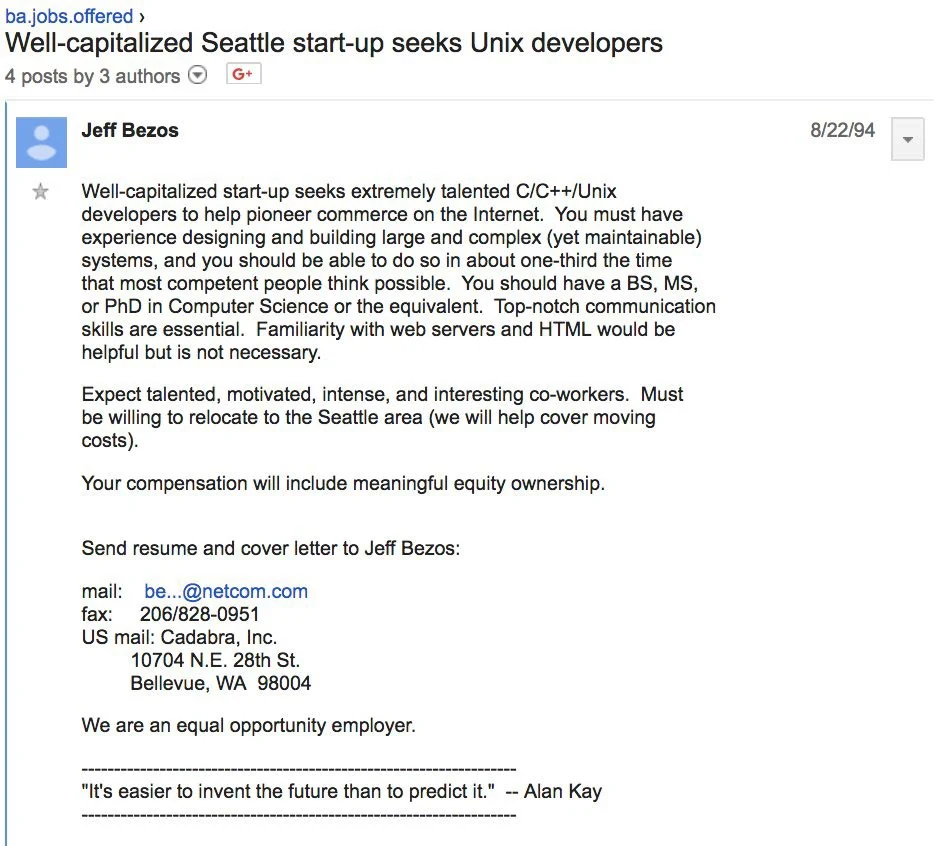
On April 12, 1994, two lawyers advertised their paid help with the US green card lottery in at least 5,500 newsgroups, the first massive commercial spam on Usenet. A few months later, in August 1994, Jeff Bezos posted a job ad in ba.jobs.offered, a San Francisco Bay Area jobs group, for a Seattle start-up called Cadabra. It began: “Well-capitalized start-up seeks extremely talented C/C++/Unix developers to help pioneer commerce on the Internet.” Cadabra became Amazon.
Archives and new hierarchies
In March 1995, Deja News launched a searchable archive of Usenet posts that anyone could use from a web browser. The same year, humanities.* joined the other seven hierarchies to make the Big 8.
Back to contentsThe 2000s to Today

Google Groups and the archive
In February 2001, Google took over Deja News and its archive and moved it to Google Groups. By the end of that year, the archive reached back to May 11, 1981, thanks to older posts donated by the University of Western Ontario and based on archives kept by Henry Spencer at the University of Toronto.
From internet providers to Usenet providers
Usenet itself kept improving: yEnc made posting files far more efficient in 2001, and PAR2 made repairing them practical in 2002. At the same time, internet providers began dropping the Usenet access they had once included. AOL stopped in 2005, Verizon in 2009 and Cox in 2010. In May 2010, even Duke, where Usenet began, shut down its own news server.
Specialist Usenet providers filled the gap, usually with far longer retention and faster connections than internet providers had offered. Fast Usenet opened in 2008.
Today
On February 22, 2024, Google Groups stopped carrying new Usenet posts, though its archive of older posts remains available. Usenet itself carries on through providers worldwide, and with retention measured in thousands of days, years of its history are still there to read. Our overview explains what people use Usenet for today.
Key takeaway
Usenet is about a decade older than the web, was the first home of some of computing’s best-known announcements, and has outlived the services that once offered it. Today specialist providers keep it running.
Usenet Timeline
- 1979Duke University graduate students Tom Truscott and Jim Ellis come up with the idea of a network for sharing news and discussion between Unix computers.
- 1980Usenet, linking Duke and the University of North Carolina, is presented at the USENIX conference in January. It gains 50 sites in its first year.
- 1980At UC Berkeley, Mary Ann Horton connects Usenet to the ARPANET and writes uuencode, which becomes the usual way to send files over Usenet.
- 1983More than 500 hosts take part, sharing about 50 articles a day.
- 1984The number of hosts nearly doubles, to 940, and there are more than 100 newsgroups.
- 1986NNTP (RFC 977) lets news travel over the internet instead of dial-up phone links.
- 1987The “Great Renaming” sorts most groups into seven main hierarchies, and the alt.* hierarchy starts the same year.
- 1991The World Wide Web (in alt.hypertext) and Linux (in comp.os.minix) are first announced on Usenet.
- 1993Internet providers start offering Usenet to many new users, and the “Eternal September” begins.
- 1994AOL opens its Usenet gateway. The first massive commercial spam hits Usenet, and Jeff Bezos posts a job ad for the company that became Amazon.
- 1995Deja News launches a searchable archive of Usenet posts, and humanities.* joins the seven to make the Big 8.
- 2001Google takes over the Deja News archive, which becomes Google Groups. yEnc arrives and makes posting files far more efficient.
- 2002PAR2 makes repairing incomplete downloads practical.
- 2005AOL ends its Usenet service, and the Big-8 Management Board forms to look after the Big 8.
- 2006NNTP is updated as RFC 3977.
- 2008Fast Usenet opens.
- 2009Verizon ends its Usenet access. The article format and the rules for how articles travel are updated (RFC 5536 and RFC 5537).
- 2010Cox drops Usenet, and Duke, where it all began, shuts down its own news server.
- 2017New guidance for encrypting Usenet connections with TLS is published (RFC 8143).
- 2024On February 22, Google Groups stops carrying new Usenet posts. Usenet itself carries on through providers worldwide.
Frequently Asked Questions
Who invented Usenet?
Tom Truscott and Jim Ellis, graduate students at Duke University, came up with the idea in 1979. Steve Bellovin, a student at the University of North Carolina, wrote the first scripts, and Usenet was established in 1980.
Is Usenet older than the internet?
Not quite. The ARPANET, the research network that grew into the internet, dates from 1969, and Usenet was established in 1980. Usenet is about a decade older than the World Wide Web, though, and since the 1990s almost all Usenet traffic has traveled over the internet.
What was Deja News?
A searchable archive of Usenet posts that launched in March 1995. Google took over Deja News and its archive in February 2001 and moved it to Google Groups.
Can I still read old Usenet posts?
Yes. Google Groups stopped carrying new Usenet posts on February 22, 2024, but its archive of older posts, reaching back to 1981, remains available. With a Usenet provider you can read years of past discussion too: Fast Usenet keeps about 18 years.
What is the Eternal September?
Usenet slang for the wave of newcomers that began in late 1993 and early 1994, when internet providers, and then AOL, began offering Usenet to many new users. Each September used to bring a new class of students who soon learned Usenet’s customs. This time the newcomers never stopped coming.
Did Usenet die when internet providers dropped it?
No. Between 2005 and 2010, providers such as AOL, Verizon and Cox stopped offering Usenet, and specialist Usenet providers filled the gap. Usenet carries on today through providers worldwide.